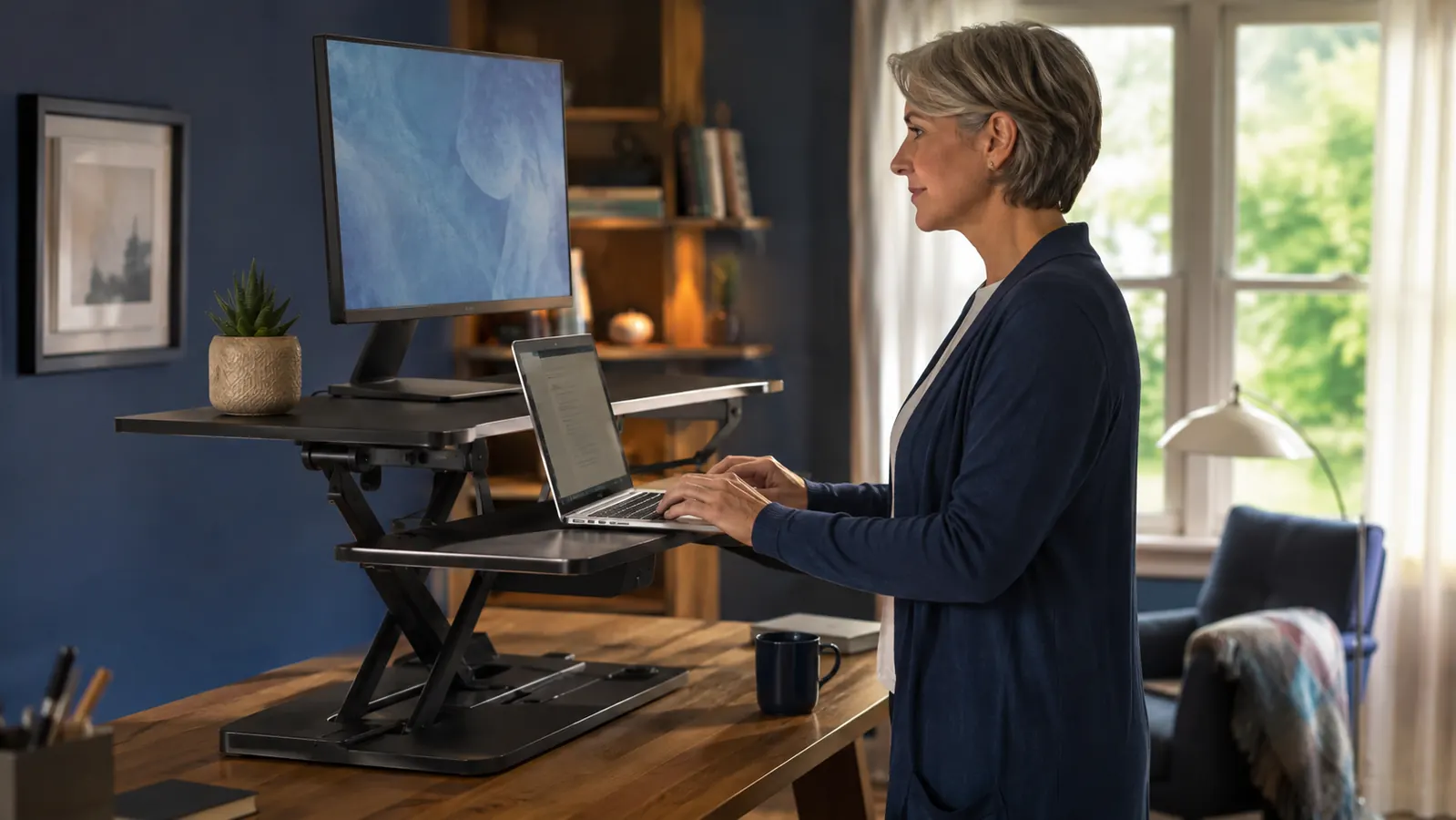
By 1 pm most days, I used to notice the same thing. My focus wasn't gone, it was just heavy. My shoulders were tight, my lower back had that dull ache from four straight hours in a desk chair, and I was reading the same paragraph of a client brief three times before it registered. I didn't need a nap. I needed to stop sitting. That's the whole case for a standing desk converter, and after two years of running my VIVO 42 inch Desk Converter K Series on top of the same kitchen-table desk I've had since 2019, here's what actually changed.
I write about desk gear for a living now, mostly for Best Home Office Setup Hub, and I get some version of the same question from readers every week. Does standing at your desk really help you focus, or is it just a habit people picked up during the work-from-home boom and never questioned? My honest answer, after living with a converter instead of a full standing desk, is that it helps in specific, unglamorous, repeatable ways. Here are the ten I noticed myself, in the order I'd rank them if I only had a minute to explain this to a friend.
The Riser That Costs Less Than a Month of Ergonomic Excuses
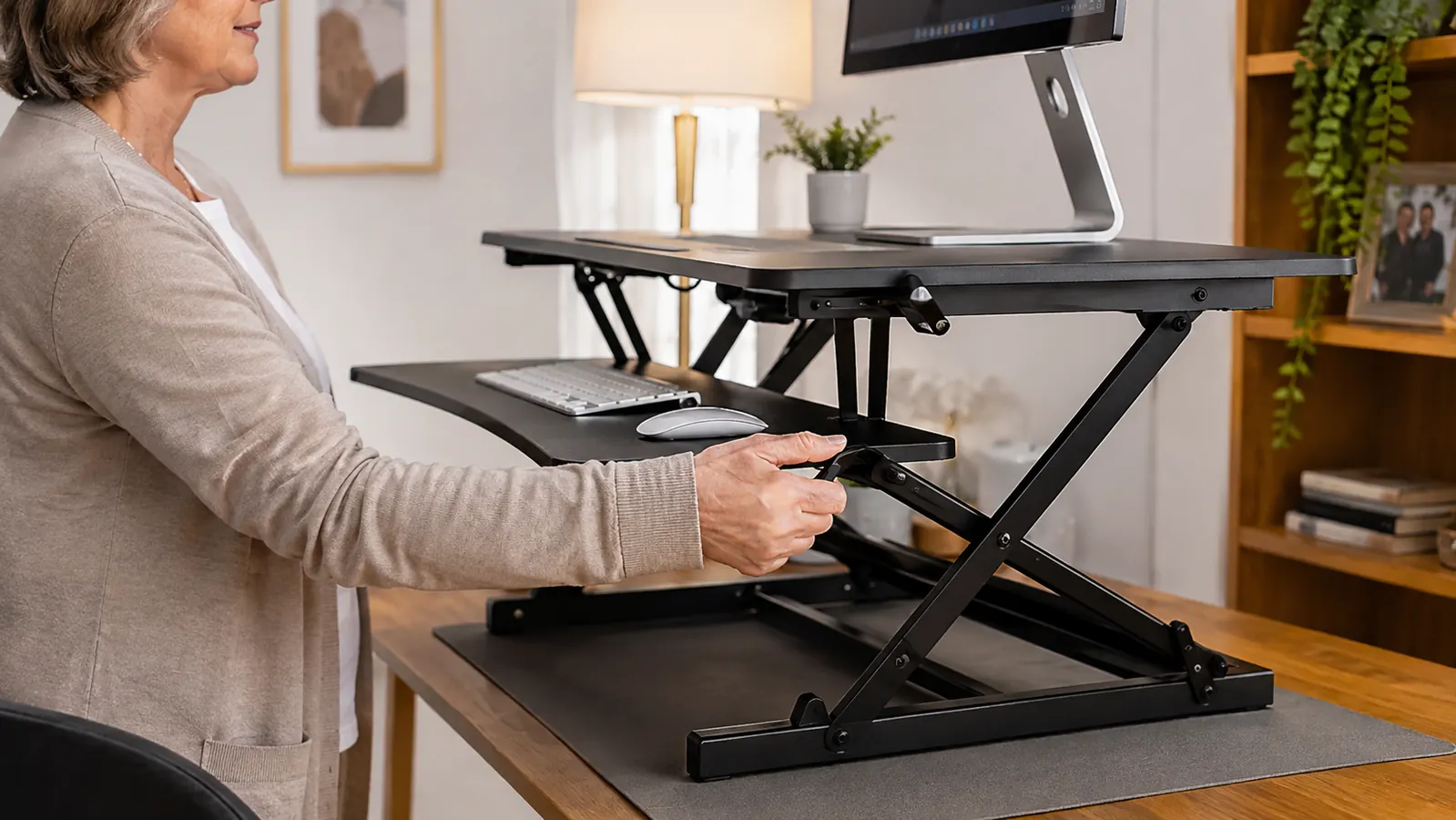
The VIVO 42 inch K Series sits directly on your current desk, holds a laptop and an external monitor at the same time, and drops from standing back to sitting in about three seconds with the side lever. No electrician, no new desk, no rearranged office.
Amazon Check Today's Price on Amazon →It Kills the "Should I Get Up" Debate
Before I had a converter, standing up to work meant negotiating with myself. Move the laptop, find a taller surface, deal with a wobbly stack of books, decide it wasn't worth the hassle, sit back down. That internal argument is where most standing intentions die. With the riser bolted to the corner of my desk, standing is a lever pull, not a decision. I've found that removing the friction from a choice matters more than the choice itself.
It Flattens the 3pm Crash
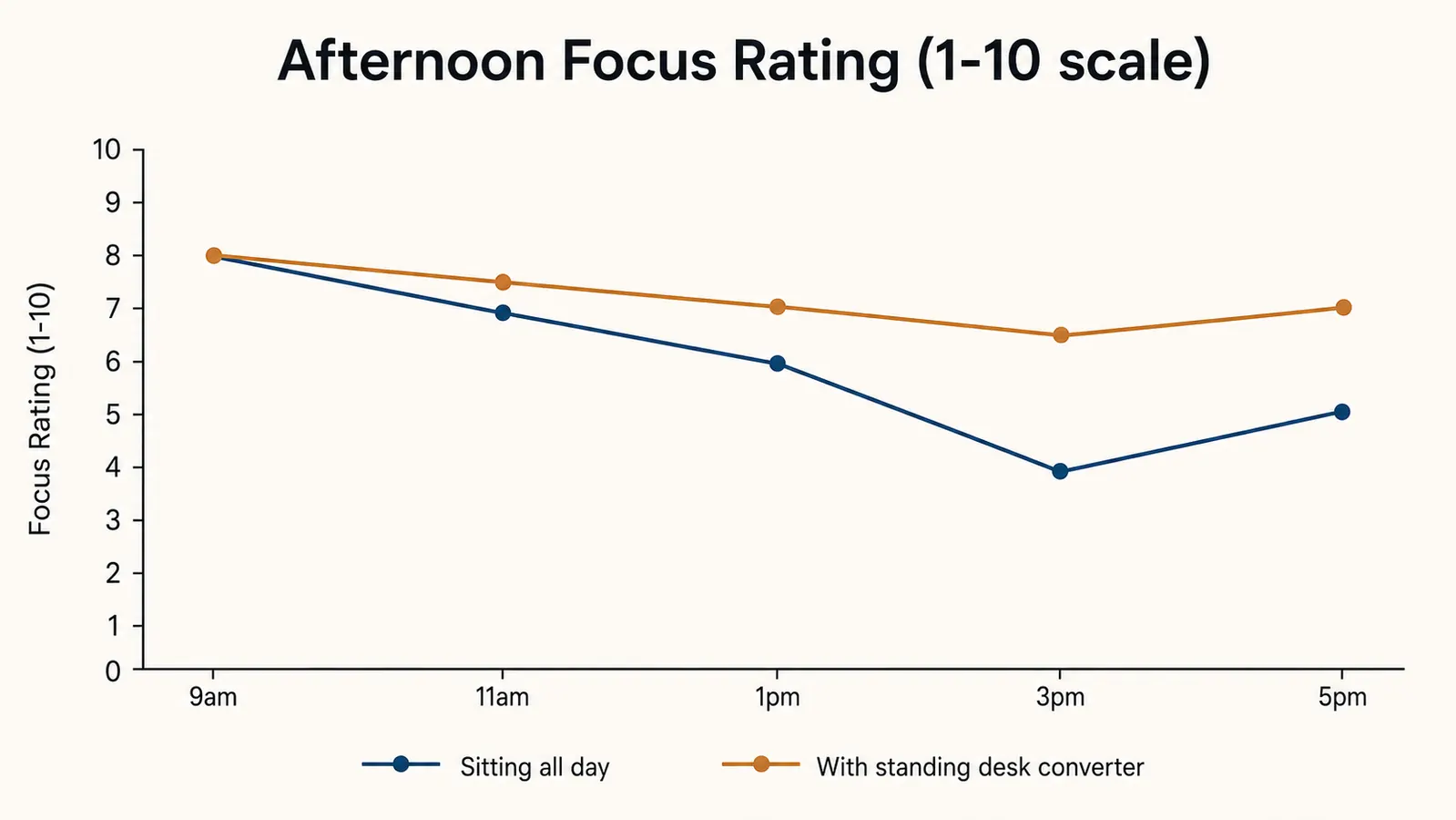
I used to track my own focus with a lazy 1-to-10 scale in a notes app, mostly out of curiosity. On sitting-only days I'd start around an 8 in the morning and be down to a 4 by 3 pm. On days where I stood for even two 25-minute stretches in the afternoon, the dip stayed closer to a 6.5 or 7. It's not a miracle fix, it's a smaller dip, but a smaller dip is the difference between finishing a task and staring at it.
It Raises Your Screen With Your Body, Not Just Your Elbows
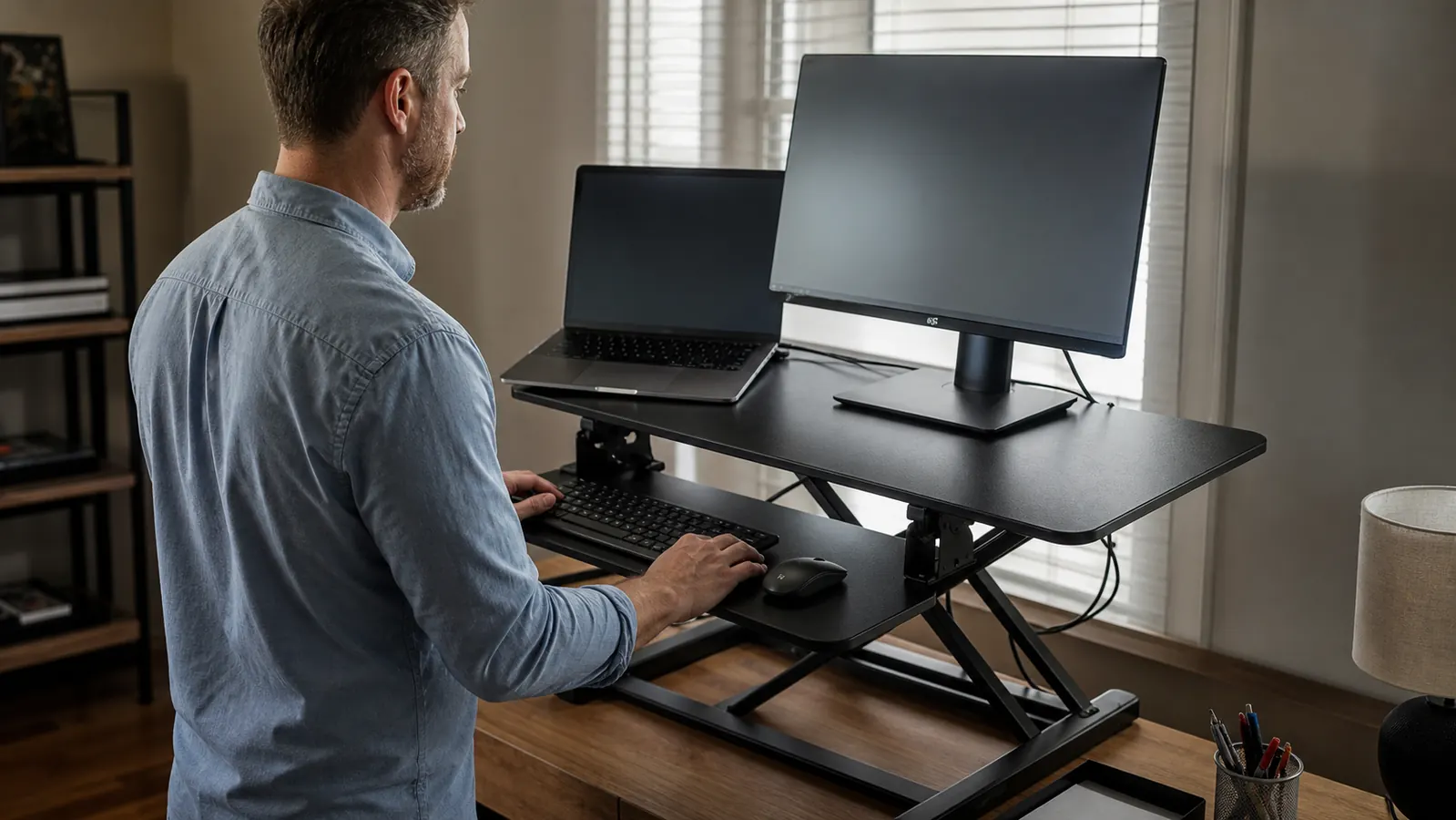
This is the part people miss when they try to improvise standing work with a stack of textbooks under a laptop. The VIVO converter has two tiers, so the monitor platform rises at the same time as the keyboard tray. My eye line stays roughly level whether I'm sitting or standing, instead of dropping six inches and forcing me to hunch to read my own screen. A hunched neck is its own distraction, and it's one I don't have to think about anymore.
It Doesn't Ask You to Buy a New Desk
A full electric standing desk usually runs $400 to $800 once you add a proper top. The converter sits at the current price of the VIVO 42 inch K Series, which is a fraction of that, and it sits on the desk you already own. If your desk itself is fine and the problem is just that you're stuck sitting at it all day, you're solving a $160-ish problem, not an $800 one.
The Switch Takes Seconds, Not a Renegotiation With Your Day
There's no app, no saved height presets, no waiting on a motor. You squeeze the side handle and the gas-spring lift does the rest, up or down, in about three seconds. That sounds small until you're mid-thought on a call and want to stand without losing your train of thought. A slow electric desk gives you time to change your mind. This doesn't.
It Handles Two Monitors Without the Wobble That Pulls Your Eyes Off the Work
I run a 27 inch external monitor next to my laptop, and the upper deck holds both without any noticeable flex when I set a coffee mug down harder than I meant to. A wobbly surface is distracting in a low-grade way, you catch it in your peripheral vision every time you type, and your brain flags it even when you're not consciously thinking about it. Solid weight capacity fixes that quietly.
It Forces Posture Variety, Which Is Its Own Focus Tool
No single position is good for eight straight hours, sitting or standing. What actually helps is changing position often enough that small aches never build into the kind of ache that competes for your attention. I alternate roughly every 45 to 60 minutes, and the small stretch of standing up resets more than my spine. It resets whatever loop I was stuck in on the screen.
It Gives Your Household a Visual "Do Not Interrupt" Signal
I have two kids who treat a seated parent at a desk as fair game for interruption, but a standing parent reads differently, closer to "busy" than "available." I didn't plan for this, I noticed it after the fact. If you work from a shared space, a visible change in your posture does some of the boundary-setting work that a closed door would in an office you don't have.
It Keeps Your Whole Setup as One Unit
When I raise the converter, my keyboard, mouse, laptop, and monitor all come up together on their own tiers. Nothing gets left behind on the lower desk surface, which used to happen with the makeshift standing setups I tried before, usually a laptop stand with the keyboard still down at sitting height. Half a standing setup is worse than no standing setup, because now you're hunching toward the low half.
It's a Focus Tool You Actually Use, Because It's Already on Your Desk
The best ergonomic upgrade is the one you don't have to remember to use. A full standing desk you never adjust helps nobody. This sits on your desk permanently, in your line of sight, so raising it becomes a habit instead of a decision you have to keep making. Two years in, I still use mine most days, and that's the real test, not the first week.
What I'd Skip
Measure your desk depth before buying any converter. Mine is 30 inches deep and the K Series fits with a few inches to spare behind it, but on a desk shallower than about 24 inches, a two-tier riser can end up hanging off the edge or crowding your keyboard space against your body. I'd also skip the pricier electric converters unless you specifically want programmable height memory. For most people switching between two or three fixed positions a day, the manual gas-spring lift on the K Series does the job at a lower cost. And don't buy a converter expecting it to replace regular movement entirely. It reduces the sitting problem, it doesn't replace a walk.
A standing desk converter doesn't fix your focus. It just removes sitting as the reason you lost it in the first place.
Your Desk Already Has Room for This
You don't need a new desk, a new office, or a weekend project. The VIVO 42 inch K Series sits on what you already own and gets you standing in under a minute the first time you set it up.
Amazon Check Today's Price on Amazon →