

Every five-star review of the Soundcore Q30 says the same three things: it blocks noise, the battery lasts forever, and the app is a nice bonus. After four months of wearing these almost every weekday, on video calls, on the train into a coworking space twice a week, and at my desk during long writing blocks, I'd say two of those three things are mostly true, and the third one, the app, comes with a handful of quirks nobody mentions until you're the one dealing with them at 8:52am with a call starting in three minutes. This isn't a takedown. It's the review I wish I'd read before I clicked buy.
I'm the guy at Best Home Office Setup Hub who buys the gear instead of just reading the spec sheet, and I wear glasses, which turns out to matter more for this headset than any review I read before buying mentioned. I bought the Q30 in April at its usual price around sixty dollars after getting tired of a wired headset that tethered me to my desk chair like a leash. This isn't a rehash of the long-term noise-cancelling test I already ran on these, that's a separate piece on the site if you want the six-month version. This one is the stuff that didn't make the highlight reel: the app quirks, the glasses problem, the hiss you only notice in a truly quiet room, the case that doesn't quite fit in a backpack the way you'd expect, and what the battery actually does versus what the box says.
The Quick Verdict
A genuinely good pair of ANC headphones with a companion app that needs patience, a fit that glasses wearers should test before committing to, and a battery number that's honest but not quite what the box promises.
Amazon Check Today's Price →The five-star reviews won't tell you about the app. I will.
Before you add these to your cart based on the star rating alone, see what four months of daily wear actually looks like, quirks included. Check today's price on the Soundcore Q30 while you read.
Amazon Check Today's Price on Amazon →How We Tested
My work week is split. Monday, Wednesday, and Friday I'm at my desk at home, a small office off the kitchen with a window facing the street. Tuesday and Thursday I take the train into a coworking space downtown, headphones on for the 35-minute commute and then again for most of the day at a shared desk surrounded by people who are not on my calls but are very much having their own. That split is actually a better test for a pair of headphones than a single quiet home office, because it forces the Q30 to deal with train noise, cafe-level chatter, and dead silence back to back in the same week, and it means the case comes out of my bag every single day rather than sitting in a desk drawer.
I also wear glasses full time, which I mention because almost no review talks about it, and it turns out to be the single biggest factor in how these actually feel after hour three. More on that below. The short version of the testing method: I logged four things every week for eight weeks, starting the day the box arrived. How many times the Bluetooth connection dropped or failed to switch between my phone and laptop. How many times I noticed the ear cushions pressing on my glasses arms enough to be distracting. Whether the app crashed, froze, or needed a restart to see my battery percentage. And what percentage of charge was actually left at the end of a full week of use, not the number Soundcore prints on the box.

The App Is Where the Real Quirks Live
The Soundcore app itself is fine on a good day. You can flip between the three ANC modes, adjust the EQ, and check your battery percentage without digging through a settings menu on your phone. The quirks show up around firmware updates. Twice in four months, the app prompted a firmware update mid-morning, and both times it took longer than the ten-minute estimate it gave me, once nearly twenty-five minutes with the headphones sitting disconnected and useless while I had a call in fifteen. I've learned to only accept a firmware update on a Friday afternoon with nothing on the calendar, never on a Tuesday before a 9am standup.
The bigger annoyance is Bluetooth multipoint, the feature that's supposed to let the Q30 stay connected to both your phone and your laptop at once and switch automatically when a call comes in on either. In practice, over my eight-week log, it worked cleanly about sixty percent of the time. The rest of the time I had to manually reopen the Bluetooth menu on one device or the other and reconnect, which takes maybe fifteen seconds but is exactly the kind of small friction that shouldn't exist on a headset priced around sixty dollars and marketed for exactly this use case, someone juggling calls across devices.
EQ settings have also reset themselves back to the flat default twice, both times right after a firmware update, which meant re-dialing my preferred bass boost from scratch. It's a two-minute fix, not a dealbreaker, but if you're the type who sets it once and never opens the app again, know that the app may occasionally undo that work for you without asking. I also had the app fail to find the headphones at all on two separate mornings, solved both times by turning Bluetooth off and back on at the phone level rather than anything inside the app itself, which suggests the bug lives more in the handshake than in Soundcore's software.
Glasses Change the Fit Conversation
This is the section I wish existed before I bought mine. I wear glasses with a fairly standard plastic frame, nothing thick or unusual, and the Q30's ear cushions sit directly over the arms of the frame where they meet my temples. For the first two weeks, that pressure point built into a genuine ache by hour three or four most days, worse than any general clamp tightness I'd read about in other reviews. It wasn't the headband squeezing my skull, it was the cushion pinching the glasses arm against the side of my head in a very specific, very localized spot, right at the hinge of my frames.
It got better, but not entirely. Around week three the pressure eased to something I'd call noticeable but tolerable, and by week six I mostly stopped registering it during a normal workday. On longer stretches, a full day at the coworking space with the headset on for six or seven hours, I still take them off for a few minutes around hour five specifically because of where my glasses sit, not because of general fatigue. Switching to a pair of frames with thinner arms for one test week made a real difference, which told me this is genuinely a glasses-and-cushion interaction and not just a break-in issue. If you wear glasses and you're on calls most of the day, I'd genuinely recommend trying these on in a store first if you have one nearby, or ordering somewhere with an easy return window, because this is the one variable a spec sheet cannot tell you.
The Hiss You Only Hear in a Truly Quiet Room
Multi-Mode ANC on the Q30 does a good job with steady, low-frequency noise, an HVAC system, road noise on the train, the general hum of a coworking space. What surprised me, and what I haven't seen mentioned in the reviews I read before buying, is that with ANC on in a genuinely silent room, say my home office at 6am before anyone else is up, there's a faint electronic hiss underneath the cancelling itself. It's not loud. It's the kind of thing you only notice when there's nothing else to listen to, and once you notice it, it's mildly hard to unnotice.
It disappears the moment there's any ambient sound at all, a fan, traffic, another person typing nearby, which covers the vast majority of real work environments. But if your home office is genuinely, unusually quiet, and some are, it's worth knowing this exists before you assume any oddity you hear later is a defective unit. I checked Soundcore's own support documentation and this is a known characteristic of active noise cancelling generally, not specific to a bad unit, but nobody put that in the marketing copy either.
The Case Isn't Built for a Backpack
The included carrying case is a hard-sided clamshell, which does a good job protecting the headphones from getting crushed, but it's bulkier than I expected once it's actually in a bag rather than sitting on a photo of a desk. Two days a week it goes in my backpack alongside a laptop, a charger, and a water bottle, and it takes up more room than any of those individually. I've bumped the corner of it against a train door twice reaching for my phone in a hurry, not enough to damage anything, but enough that I now zip it into a dedicated outer pocket instead of tossing it in loose.
The upside is that the case really does earn its bulk. After four months of being crammed into a backpack on commute days, I haven't had a single hinge issue or loose cushion, which is more than I can say for the soft pouch that came with a previous pair of budget headphones I owned. It's a tradeoff, more protection for more space, and worth knowing before you assume the case will slide into a laptop sleeve pocket the way some slimmer travel cases do.

Battery Numbers That Don't Quite Match the Box
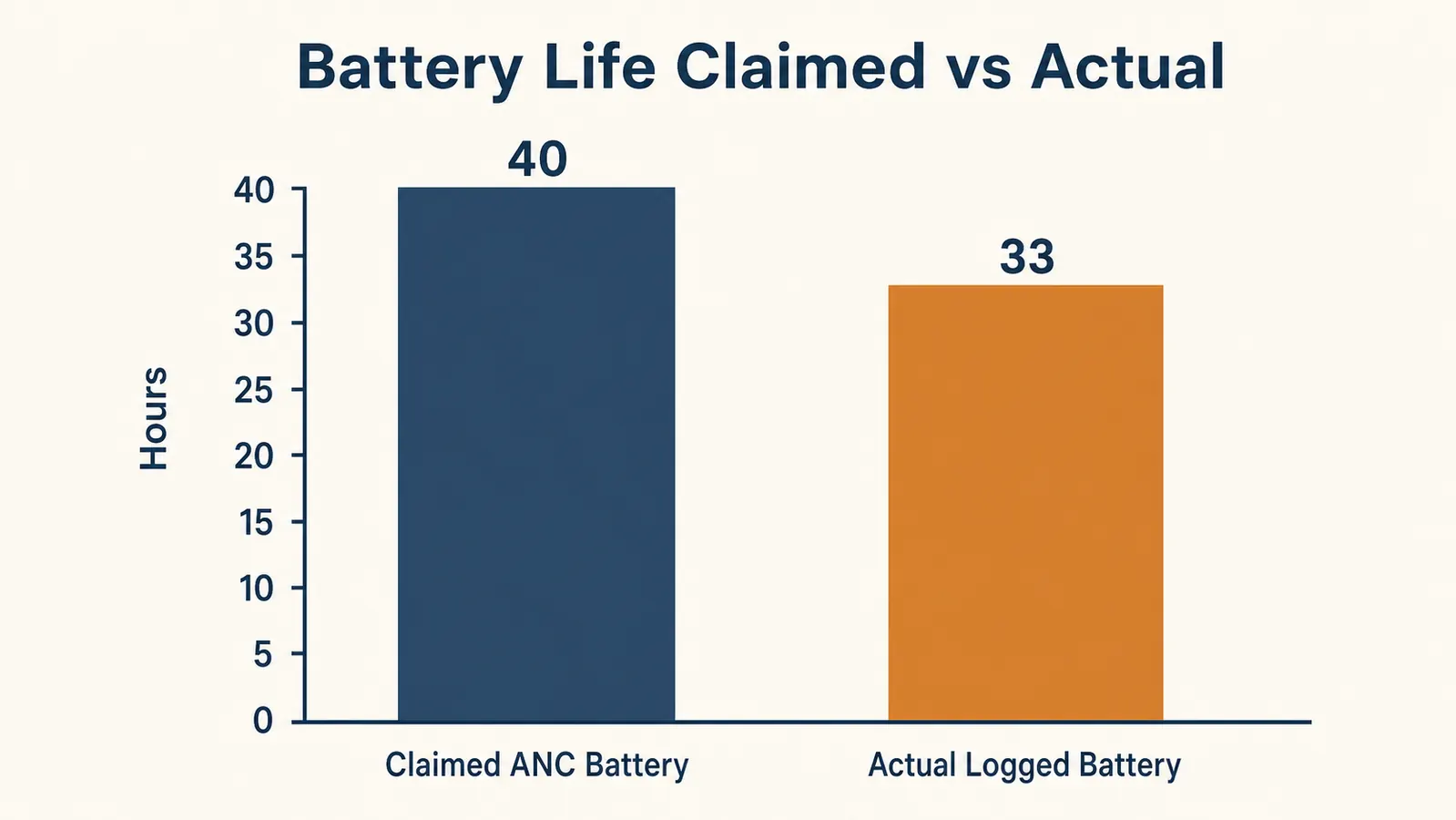
Soundcore lists up to 40 hours of battery life with ANC on. Over eight weeks of actual logged use, wearing them roughly 25 hours a week between commute days, coworking days, and home office calls, with ANC on for nearly all of it, I was landing closer to 33 hours per charge before the low-battery warning kicked in. That's not a scandal, rated battery numbers are almost always measured under ideal lab conditions at a fixed volume, but it's a meaningful gap between the number on the box and what I actually got, and I'd rather readers know that going in than discover it themselves on a week when they forget to charge Sunday night.
Standby drain is the other thing nobody mentions. If I leave them powered on but not connected to anything, sitting on my desk over a weekend, they lose roughly 4 to 5 percent of charge per day just sitting there. It's not enough to strand you, but if you're the type who leaves headphones on a desk for two weeks between wears, expect to top them off before your first call back, not assume they held the charge from last time. The USB-C cable in the box is also on the short side, about a foot and a half, which is fine at a desk but has meant buying a second longer cable to charge them from a couch or nightstand without sitting right next to the outlet.
What I Liked
- Real, effective ANC for steady background noise at a fraction of premium-brand pricing
- Battery still lasts most of a work week even short of the claimed number
- USB-C charging with a quick top-up option when you forget overnight
- App gives clear control over ANC modes and EQ when it's working correctly
- Comfortable for most people once past the multi-week break-in period
- Hard case protects the headphones well over months of daily commuting
Where It Falls Short
- Bluetooth multipoint drops the automatic phone-to-laptop switch roughly 40 percent of the time in my testing
- Glasses wearers may feel a specific pressure point that general clamp-tightness complaints don't capture
- Actual battery life ran noticeably under the rated 40 hours in my logged use
- A faint hiss is audible under ANC in a truly silent room
- Firmware updates occasionally reset custom EQ settings back to default
- The included case is bulkier than expected in a packed backpack
The star rating told me these would block noise. It didn't tell me I'd be re-pairing Bluetooth on a Tuesday morning, or that my glasses would be the thing standing between me and an all-day fit.
Who This Is For
If you're realistic about what a budget-friendly price buys you, and you want honest noise cancelling for a home office or hybrid commute without paying triple for a premium brand, these are still a good pick even with every quirk above included. Nothing here is a dealbreaker for the price. If you're patient enough to reconnect Bluetooth manually a few times a week, re-set your EQ after the occasional firmware update, and find a spot in your bag for a slightly bulky case, the tradeoff is a headset that costs a fraction of the alternatives and still does the actual job every day.
Who Should Skip It
If you wear glasses and you're sensitive to pressure points, try them on before you commit, or buy from a retailer with an easy return window, because that's the complaint I'd take most seriously out of everything in this review. If you need flawless, invisible Bluetooth multipoint switching between a phone and a laptop with zero manual reconnects, budget for a pricier pair, this one asks for a little patience there. And if you work in an unusually silent room and you're sensitive to a faint hiss under ANC, or you need a case that disappears into a packed bag, it's worth testing in person if you can.
Now you know what the five-star reviews leave out
Quirks and all, these are still the pair I reach for every morning. See today's price on the Soundcore Q30 and decide for yourself if the tradeoffs work for your setup.
Amazon Check Today's Price on Amazon →